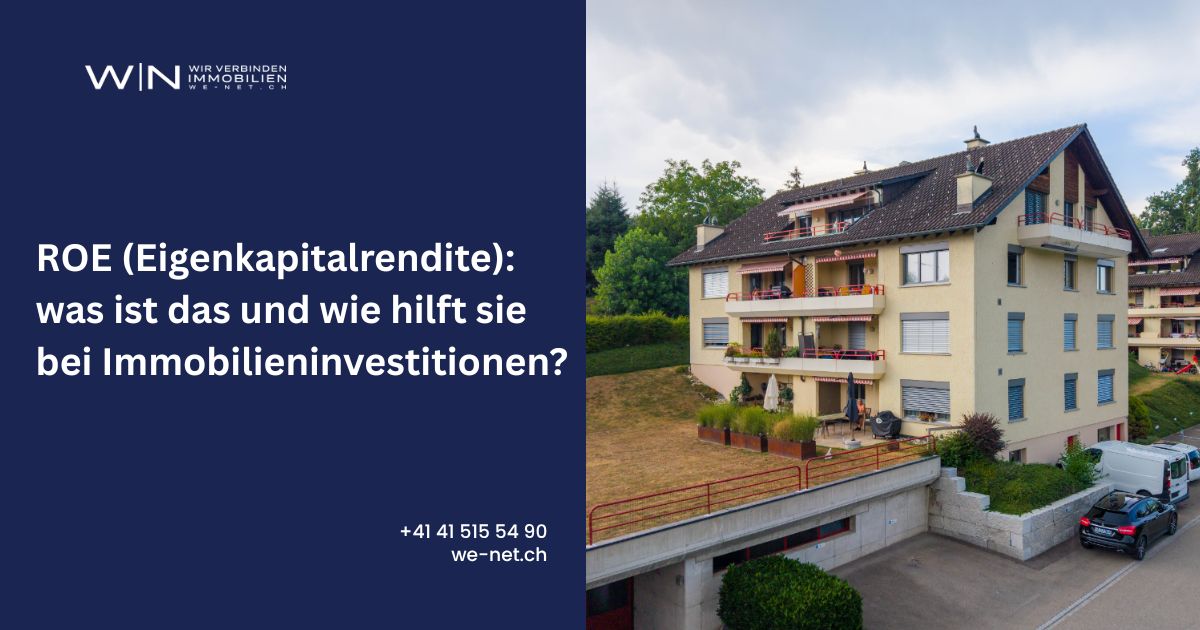
When buying an income-generating property, many investors first ask themselves: Is it worth it? The gross yield alone only provides a superficial answer, as it doesn't take into account debt financing or its associated costs. Anyone wanting to know how efficiently their own, actually invested capital is working cannot ignore one key figure: the return on equity, or ROE for short. In this article, we explain what this metric represents and why it is often more meaningful for real estate investments than other return-on-investment metrics.
What exactly does return on equity measure?
The return on equity relates the profit generated by a property to the equity invested – not to the total purchase price. It thus answers the crucial question for investors: How much return do I get on the money I've invested myself?
The formula at a glance
In simplified terms, the ROE can be calculated as follows:
- Annual profit after interest (Rental income less operating costs, maintenance and interest on borrowed capital)
- divided by
- equity capital employed (the portion of the purchase price that was not financed by a mortgage)
The result is expressed as a percentage and allows a direct comparison of different investment opportunities – regardless of how large or expensive the respective property is.
The leverage effect of debt financing
The real appeal of return on equity (ROE) lies in the so-called leverage effect: As long as the total return on the property is higher than the mortgage interest rate, a higher debt-to-equity ratio increases the ROE disproportionately. For example, if only 20 percent equity is used instead of 40 percent, the same profit is spread over a smaller capital base – the percentage return increases noticeably. However, this effect works in both directions: If rental income falls or interest rates rise, the leverage works just as strongly against the investment. This is precisely why return on equity should never be considered in isolation, but always in conjunction with affordability and interest rate risks.
Why return on equity is so important in real estate investments
For investors who want to compare multiple properties or expand their portfolio, the ROE is more meaningful than the pure gross or net yield for several reasons:
- It shows how efficiently one's own capital is used – not just how profitable the object itself is.
- It makes different financing structures comparable, even for similar properties with different debt financing shares.
- It helps to strategically manage the financing strategy, instead of focusing solely on the purchase price or the location.
Limitations of the key figure in practice
The ROE is not an end in itself and should not be used as the sole basis for decision-making. It does not take into account potential for value appreciation or liquidity risks during short-term market fluctuations, and high debt financing can make the metric appear attractive in the short term, even though the actual risk increases. A sound investment decision therefore only arises from the interplay of ROE, affordability analysis, property quality, and market conditions.
Those who consider real estate as an investment should understand the return on equity as one of several factors – important, but not sufficient on its own. In practice, it is repeatedly shown that properties with identical purchase prices can differ significantly in their actual return depending on the financing structure. Those who understand this difference and use it strategically make more informed investment decisions.
Conclusion
Return on equity (ROE) shows how efficiently one's own capital is actually working – and thus often reveals whether an investment is truly worthwhile. Those who understand and strategically utilize the leverage effect can significantly increase their return, but simultaneously bear a higher risk in the event of declining yields or rising interest rates. Ultimately, there is no way around always considering ROE within the context of affordability, property quality, and market conditions, rather than evaluating it in isolation.