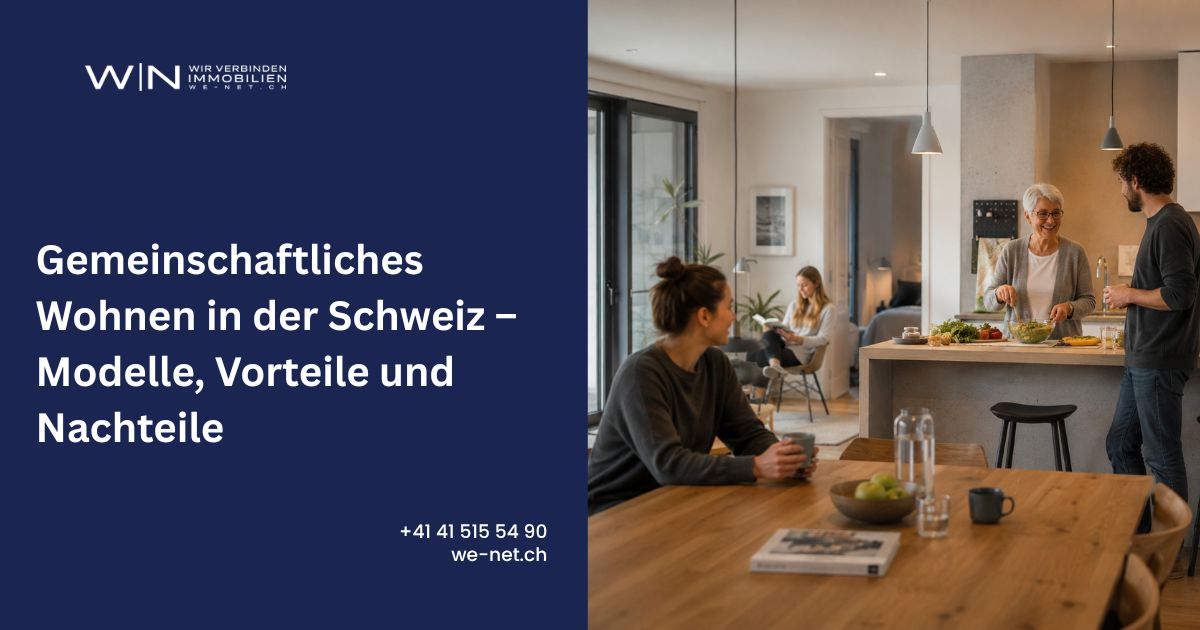
The classic single-family home idyll is no longer everyone's goal. Rising land prices, the desire for social interaction, and a growing awareness of resource-efficient construction have given rise to a whole range of communal living models in Switzerland. From traditional cooperatives to modern cluster layouts, the models differ significantly in organization, costs, and daily life. Anyone considering moving to or investing in such a project should be aware of these differences.
What models of communal living exist?
Co-housing is not a uniform concept, but rather a collective term for very different sponsoring organizations and floor plan types. Three models are particularly prominent in the Swiss market.
Housing cooperatives
Cooperatives are the oldest and by far the most widespread form of communal living in Switzerland, especially in cities like Zurich, Basel, and Bern. Members purchase shares and, in return, receive permanent tenancy rights at cost-covering rents, often significantly below the local market rate. The right to participate in decisions regarding renovations, landscaping, and community activities is a fundamental principle.
Multi-generational and cluster apartments
In this model, several generations or households live under one roof, but share clearly defined private retreats. Cluster floor plans combine small, individual living units with generous communal areas such as a kitchen, laundry room, or roof terrace. This model is particularly attractive for families with care needs or older people who do not wish to live alone.
Privately owned co-housing projects
Unlike cooperatives, these projects are backed by private owners' associations or foundations. The residents are often involved in the planning from the very beginning – from the architecture to the future house rules. Such projects are increasingly emerging in the outskirts of larger cities, where building land is cheaper and the demand for alternative forms of housing is growing.
Advantages and disadvantages in everyday life
Those who opt for communal living exchange traditional individuality for closeness, exchange, and often lower costs. Whether this is worthwhile depends heavily on personal lifestyle.
Advantages:
- Lower housing costs thanks to cost-covering rents or shared infrastructure
- Social support in everyday life, for example with childcare or in old age
- Resource conservation through shared spaces and equipment
- Long-term planning security with cooperative housing law
Disadvantages:
- Less privacy and a greater need for coordination in everyday life
- Participation processes can slow down decision-making.
- Waiting lists at established cooperatives are often long.
- Resale or transfer of the right of residence is often restricted
The decision for or against a cohousing model ultimately depends on one's stage of life: those seeking community and cost-efficiency will find attractive solutions here. Those who prioritize maximum freedom regarding renovations and resale are often better served by traditional home ownership.
At WENET, we have been supporting property owners in Switzerland for over 50 years – from classic villas to special cooperative housing projects. This experience has repeatedly shown us that the right type of housing cannot be determined by a one-size-fits-all approach, but only through a conversation with someone who understands the local market and the legal intricacies. If you are looking to buy, sell, or have a property with a communal living concept appraised, you've come to the right place.
Conclusion
Communal living is no longer a niche in Switzerland, but a serious alternative to traditional home ownership. Whether cooperative, multigenerational housing, or private co-housing project – each model comes with its own set of rules that directly impact costs, participation rights, and flexibility. Those who familiarize themselves with the differences early on and honestly reflect on their own life stage will ultimately make a decision that fits their everyday life, rather than working against it.