
The transition to retirement changes many things – including the financial situation regarding one's own property. Those who have financed their home with earned income for decades suddenly find themselves confronted with different standards upon retirement. The bank reassesses affordability, and often a shortfall emerges that should be addressed early on. However, those who understand the mechanisms can actively manage this phase without unpleasant surprises.
Why mortgages become a challenge in old age
Upon reaching retirement age, disposable income typically drops significantly – often to 60 to 70 percent of the last salary. For the mortgage, this means that the calculations, which worked perfectly during one's working life, need to be recalculated.
Affordability recalculated: Pension instead of wages
Banks continue to calculate affordability using a notional interest rate of typically 5 percent, plus ancillary costs and amortization, compared to the actual retirement income from state pension and occupational pension fund. If these costs exceed roughly one-third of the income, the mortgage is considered unaffordable – regardless of how reliably interest payments have been made in the past. This particularly affects homeowners who have never repaid their mortgage because, for a long time, this was not tax-efficient.
The amortization obligation and its pitfalls
In addition, most institutions require that the second mortgage – the portion exceeding 65 percent of the loan-to-value ratio – be repaid by retirement at the latest or within 15 years. Those who lose sight of this deadline can easily fall behind on their amortization payments. This, in turn, can lead to the bank renegotiating the terms at the next fixed-interest period or, in rare cases, even demanding a reduction in the mortgage amount.
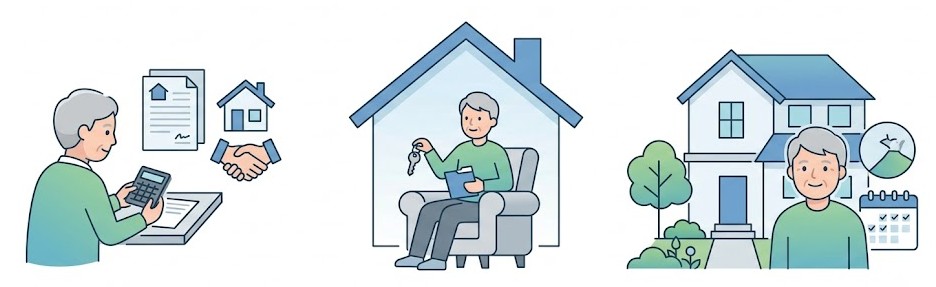
Strategies for secure retirement financing
The good news is that most of these pitfalls can be avoided with sufficient lead time. The key is to analyze the situation not just at retirement, but five to ten years beforehand.
Indirect amortization and tax optimization
A proven solution is indirect amortization via Pillar 3a or a life insurance policy: The mortgage debt formally remains, while capital is simultaneously accumulated, which is tax-deductible and reduces wealth tax in retirement. Partial early withdrawal of pension fund assets, an extension of the repayment period by the bank, or a loan-to-value split among several heirs can also be sensible options. Which combination makes the most sense in a given case depends heavily on the individual's retirement savings situation, the market value of the property, and family plans.
At WENET AG, we have been guiding property owners through precisely these kinds of transitions for over 50 years. From this long experience, we know that an early and honest assessment of one's own affordability is the most important step – often more important than the choice of a specific financing instrument. An independent valuation of the property's current market value provides the foundation for negotiating with the bank on equal footing, whether for extending the amortization period or exploring a partial sale.
If affordability and your desired outcome don't align, there's no need to worry; it's the perfect opportunity to systematically explore your options. We'll take the time for a personal consultation to assess your property and work with you to develop the right solution for your specific circumstances – whether that ultimately involves adjusting your financing, restructuring, or selling.
Conclusion
A mortgage in retirement is not obsolete, but rather a financing option that requires timely review and adjustment. Understanding the changed affordability calculations, amortization periods, and available solutions allows for relaxed planning of retirement in one's own home, instead of being caught off guard by the bank. Early assessment of one's financial situation, appropriate retirement planning tools, and a realistic valuation of the property value can secure long-term financial security in old age.