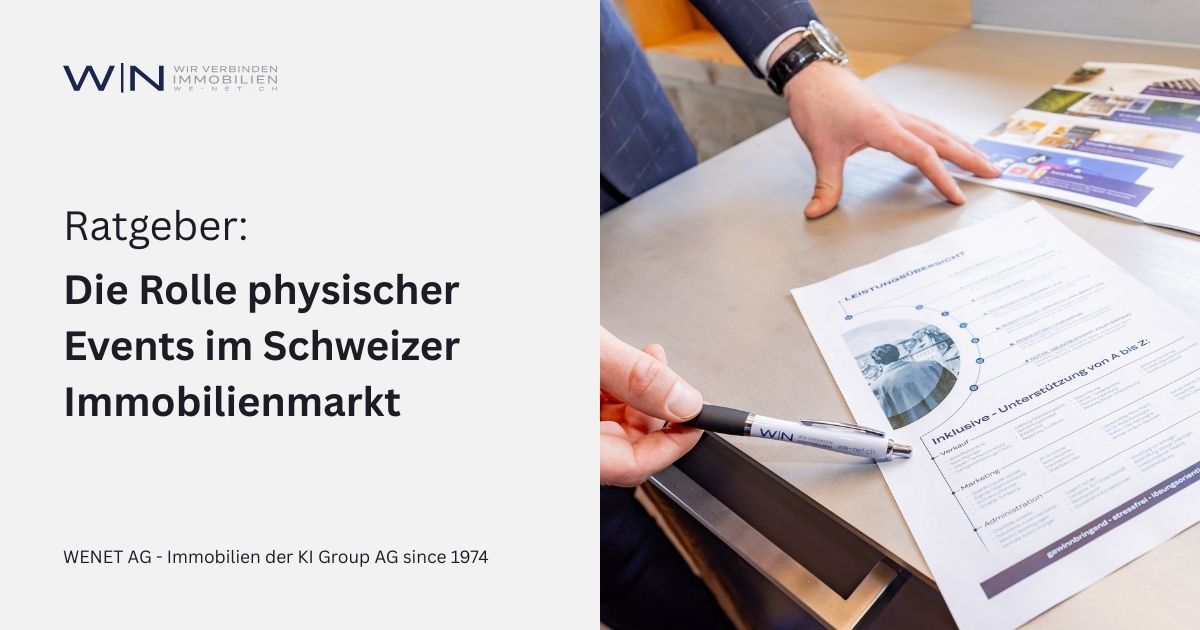
In an increasingly digital real estate market, physical events remain of central importance in Switzerland. While online platforms provide visibility and initial inquiries, the actual decision-making often only takes place through personal contact. Especially in a market characterized by trust, discretion, and long-term thinking, direct encounters play a crucial role.
A market based on trust and personal contact
Real estate transactions in Switzerland are rarely impulsive. Buyers and investors typically approach decisions in a structured and meticulous manner. Transparency, reliability, and a clear understanding of the framework are paramount. This is precisely where physical events come into play.
Whether during a viewing or an information session, personal interaction allows for immediate clarification of open questions and a better understanding of the property and the parties involved. In addition to hard facts such as location, condition, and price, soft factors also play a role: How professional is the presentation? How competent is the contact person? How coherent is the overall impression?
These aspects can only be conveyed digitally to a limited extent. In practice, it has been shown that high-quality properties or objects requiring explanation benefit greatly from a personal setting.
Digital reach vs. physical conversion
Digital channels are indispensable in modern real estate marketing. They enable broad outreach, targeted marketing, and efficient pre-qualification of potential buyers. However, the process rarely ends online.
Physical events serve a different function: they create commitment. While online listings spark interest, personal encounters often lead to concrete decision-making. In many cases, it is only in person that a potential interested party becomes a serious buyer.
A well-thought-out interplay of both levels – digital and physical – therefore forms the basis of a successful marketing strategy.
Open House Events – More than just tours
Open house events are often perceived as simple viewing appointments. However, when used correctly, they are a strategic tool for concentrating demand, generating momentum, and strategically positioning properties.
When open house formats are particularly useful
Not every property is equally suitable for an open house format. Such events are particularly effective for properties with a broad target audience, in sought-after locations, or in market situations where several potential buyers need to be addressed simultaneously.
Even with new construction projects or extensively renovated properties, a structured viewing appointment can help to make the quality of the property tangible and to efficiently coordinate different interested parties.
Structured vs. open formats
The design of an open house event has a significant impact on its effectiveness. Basically, two approaches can be distinguished: guided tours and open tours.
Guided tours
Guided tours allow prospective buyers to be accompanied through the property in small groups or individually. This enables targeted communication, a clear structure, and the opportunity to address individual questions. This format offers clear added value, especially for higher-priced properties or more complex offerings.
Open tours
Open-plan layouts allow prospective buyers to move freely through the property. This creates a more relaxed atmosphere and can be particularly useful when demand is high. At the same time, it requires careful organization to ensure a professional impression.
Psychological Dynamics in the Open House
An often underestimated aspect of open house events is their psychological effect. When several prospective buyers are present at the same time, a kind of social dynamic emerges. The perception that other people are also showing serious interest can increase the likelihood of making a decision.
Furthermore, a well-attended event conveys a sense of demand and attractiveness. However, it is important that these effects are not artificially created, but rather result from a realistic market situation.
Lectures and information events as a basis for trust
In addition to traditional viewings, lectures and information events in the real estate sector are also gaining in importance. They shift the focus from pure marketing to knowledge transfer and positioning.
Typical formats in the Swiss market
In practice, various formats have become established. These include information evenings for first-time buyers, events on tax issues, or market analyses with a regional focus. Such events appeal to different target groups and offer the opportunity to present complex topics in an understandable way.
These formats are often created in collaboration with other experts, for example from the fields of finance or taxes, which opens up additional perspectives and strengthens credibility.
Positioning through expertise
Sharing knowledge builds trust. Information events offer an opportunity to demonstrate expertise without direct sales pressure. For many participants, the focus is not on an immediate transaction, but rather on gaining a better understanding of the market and their own capabilities.
In the long term, this creates a relationship that extends far beyond a single point of contact. In practice, this form of positioning has proven to be a crucial difference for companies that operate sustainably in the market.

Personal encounters during viewings build trust and allow for direct answers to questions – a crucial advantage over purely digital formats.
Investor invitations – A different level of real estate events
While open house events and presentations primarily target buyers and end users, investor invitations are aimed at a specific audience: investors who are specifically seeking high-yield, often exclusive projects. Experience in Switzerland has shown that such events not only serve to showcase real estate but are also indispensable as a strategic tool for cultivating relationships and building trust.
Private vs. semi-private formats
Investor events can take many forms. Private events are typically strictly exclusive, often by invitation only, and sometimes subject to a non-disclosure agreement (NDA). Semi-private formats offer a slightly larger number of participants but maintain a clearly controlled environment. Crucially, the exclusivity and professionalism should reflect the perception of the investment.
Swiss investors' expectations
Swiss investors place particular emphasis on transparency, security, and comprehensible analyses. Return forecasts must be realistic, risks clearly communicated, and all legal requirements adhered to. Careful preparation and a well-thought-out event design are therefore crucial for gaining trust and building long-term relationships.
Presenting opportunities effectively
The way real estate projects are presented to investors can make the difference between interest and commitment. For off-market projects, meaning those not publicly marketed, a structured, professional setting is particularly important. The same applies to larger development projects that require explanation and a deeper understanding of market dynamics.
Off-market deals
Off-market properties offer investors a distinct advantage: access to projects that are not yet on the market. A professionally organized event creates transparency, clarifies open questions, and strengthens trust in the project developers.
Development projects
For complex projects, personal interaction is crucial. Presentations should communicate not only the figures, but also the vision, the concept, and the planned implementation steps. This builds trust and clearly illustrates the risks for investors.
From event to sustainable relationship
An event is never an isolated point of contact. The real value is created in the follow-up and long-term relationship management. Interested parties become partners when communication, professionalism, and follow-up are consistently implemented.
Follow-up as a crucial value driver
After the event, the phase begins in which contacts are cultivated, questions are answered, and relationships are deepened. Targeted follow-up, combined with further information, personal conversations, and regular updates, transforms one-time participation into lasting trust.
Building long-term investor relationships
Through strategic planning and continuous communication, companies can build long-term relationships. Swiss investors value a transparent, reliable partnership. Events thus become an integral part of a comprehensive, trust-based strategy that extends far beyond the day of the event.
Events as part of a holistic strategy
To fully leverage the benefits of open house events, presentations, and investor invitations, it's advisable to integrate them into a broader marketing and communications plan. Combining digital touchpoints with physical encounters ensures reach, efficiency, and sustainability.
Connecting digital and physical touchpoints
Digital channels support event promotion, provide additional information, and enable initial pre-qualification. On-site, physical formats build trust, facilitate in-depth discussions, and encourage decision-making. A well-coordinated combination of these elements maximizes the impact.
Consistency and positioning
Continuity in event design, clear communication, and in-depth expertise ensure sustainable positioning. Companies that regularly host high-quality events and share their knowledge establish themselves as reliable market players. In practice, it turns out that this consistent, professionally implemented strategy makes all the difference.
Conclusion: Strategic levers for the Swiss real estate market
Open house events, lectures, and investor invitations are far more than just individual marketing activities. They are strategic levers that build trust, deepen relationships, and secure long-term market positions. Those who plan, execute, and follow up on these formats professionally reap lasting benefits.
Companies like WENET AG demonstrate in practice how such events can be optimally designed: from selecting the format and targeted communication to professional follow-up. This transforms events not only into a communication tool, but also into a crucial component of real estate strategy in Switzerland.