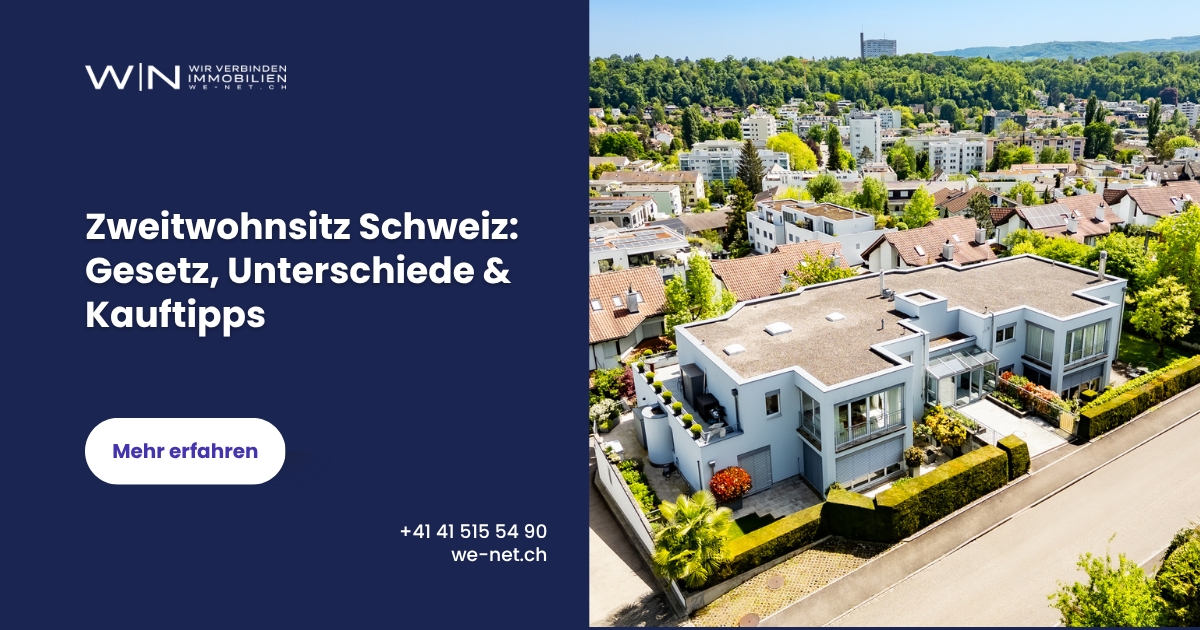
SECOND HOME - SECONDARY/PRIMARY RESIDENCE? DIFFERENCES TO THE REGULATION IN SWITZERLAND
In Switzerland, the principle of «unity of residence» applies. This means that, in principle, you can only have one residence in the true sense of the word within the Swiss Confederation, namely a main residence or primary residence. However, there are exceptions for so-called secondary residences in Switzerland, such as holiday homes.
With the adoption of the second homes initiative in 2012, Swiss voters voted in favour of restricting the construction of second homes. The Federal Act on Second Homes (ZWG) implements the constitutional article (Art. 75b BV) and has been in force since 1 January 2016. All municipalities are obliged to compile an annual housing inventory. «Cold beds» and «empty flats» - these were the buzzwords used to convince the Swiss people in March 2012 to restrict the construction of new second homes. The law implementing this came into force. At the time, Susanne Leutenegger Oberholzer, SP National Councillor for Basel, campaigned for the adoption of the second homes initiative. It became known that she had bought her own second home shortly before the vote. Two weeks before the vote, Mrs Leutenegger Oberholzer bought a second home in the holiday village of Valbella, which belongs to the political municipality of Vaz/Obervaz. According to federal building and housing statistics, there are around 5,300 flats in Vaz/Obervaz. According to estimates, 76.6% of these are second homes. The purchase would have been possible even after the vote, as the use of traditional flats remains free.
Is such a purchase still possible today under the new legal situation? And what points need to be considered?
We provide comprehensive answers to these and other questions in our article on the topic of second homes in Switzerland.
LEGAL BASIS: POPULAR INITIATIVE AND SECOND HOMES ACT
Ordinance on the second home initiative:
The so-called Second Homes Ordinance has been in force since 1 January 2013 (following the adoption of Franz Weber's popular initiative «Stop the unbridled construction of second homes», which was voted on 11 March 2012). It applies to the construction of new second homes in municipalities with a proportion of second homes of more than 20%. Such municipalities may only authorise new second homes under strictly defined conditions.
Definition of a flat:
It seems clear what a flat is. However, the law is precise and defines a dwelling as a structural unit of rooms that is habitable and has a kitchen (Art. 2 para. 1 ZWG). Let us therefore look at when a dwelling is considered a primary residence in order to derive the definition of a secondary residence.
Primary residence:
A primary residence is deemed to exist if the dwelling is used by at least one person who has settled in the municipality (Art. 2 Para. 2 ZWG). A dwelling is equivalent to a primary residence if it:
- is permanently occupied for the purpose of gainful employment or education;
- is permanently occupied by a private household that permanently occupies another dwelling in the same building;
- is occupied by persons who are not required to register with the Residents' Registration Office (e.g. diplomats);
- has been vacant for less than one year, is habitable and is offered for permanent rental or sale (so-called empty flats);
- is used for agricultural purposes and is not accessible all year round due to its altitude;
- is used for the short-term accommodation of company personnel;
- is used as official accommodation (hospitality industry, hospital or care homes);
- or is lawfully and temporarily used for purposes other than housing (Art. 2 para. 3 ZWG).
WHAT IS A SECONDARY RESIDENCE ACCORDING TO THE LAW?
Second homes within the meaning of the ZWG are dwellings that are neither primary residences nor equivalent to primary residences (Art. 2 Para. 4 ZWG). These are dwellings that are not permanently used by persons with their main residence in the municipality concerned, nor for professional or educational purposes. Second homes in Switzerland are generally used for holiday purposes and are often rented out to third parties.
The restrictionNew second homes are only permitted in municipalities in which the proportion of second homes does not exceed 20% of all dwellings. Existing second homes remain in place. New flats will only be authorised in affected municipalities if they are primary residences or are managed for tourism purposes. Anyone who does not comply with the regulations risks a fine and the forced letting of the flat.
SECOND HOME, SECONDARY RESIDENCE OR PRIMARY RESIDENCE? THE DIFFERENCES UNDER HOUSING LAW
A secondary residence according to the ZWG is not the same as a secondary residence or a 2nd residence in terms of registration law.
Although the term «secondary residence in Switzerland» is regularly used, it does not exist from a legal perspective in the strict sense, as the principle of «unity of residence» applies in Switzerland. You may only have one residence in the strict sense (the centre of life).
A so-called secondary residence usually serves educational or work purposes (so-called «weekly residence») and is legally qualified as a place of residence, not as a domicile.
The centre of life is decisive:
- For families, the family's place of residence is the main place of residence, even if you spend more time at your place of work.
- For individuals, the centre of life can be the place where you work during the week - even if you return to your main residence at the weekend.
- You pay taxes in Switzerland at your main place of residence. Only taxes relating to property ownership are due in the relevant municipality.
Depending on personal circumstances, the following situations may be considered as a place of residence for so-called weekly residents:
- Priority of the place of work over the family home
- Priority of the family location over the place of work
- Separate residences of spouses
- Cross-border secondary residence
SPECIAL CASE STUDIES
Registering a permanent camper as a second home?
Is living on a permanent campsite a secondary residence? This is prohibited in many municipalities in order to avoid so-called «trailer parks». Many municipalities prohibit the permanent use of campsites. The situation is even stricter when it comes to main residences: although permanent campsites are often set up as a main residence, official living on campsites is rarely permitted. Overnight stays are often only permitted for a certain period or a limited number of days or months. Anyone living on a campsite or in a Tiny House for 100% must register this as their primary or main residence.
Sanctions in the event of non-compliance
If a dwelling is not being used lawfully, the competent authority can proceed as follows:
- It demands a grace period for use in compliance with the conditions.
- Otherwise, it can have the flat sealed and impose a fine of up to CHF 10,000 (Art. 292 StGB).
- The flat can then be rented out by the municipality (Art. 18 ZWG).
Construction ban (20% limit)
No new second homes may be built in any municipality with a proportion of second homes of more than 20% (Art. 6 Para. 1 ZWG).
Determination of the proportion of second homes
Every municipality in Switzerland is obliged to compile an inventory of dwellings (Art. 4 ZWG). Based on the number of flats and the number of primary residences (including equivalent flats), the number of secondary residences and thus the percentage share can be determined.
Obligation to inventory the flatYes. If a municipality fails to draw up an inventory, it is assumed that the proportion of second homes in the municipality in question is higher than 20% (Art. 5 Para. 2 ZWG).
New buildings in municipalities with over 20% of second homes
If a municipality has a proportion of second homes of over 20%, new flats may only be authorised if they are used as follows:
- Primary residence
- Dwelling that is equivalent to a primary residence
- Tourist flat (Art. 7 para. 1 ZWG)
Such new flats are subject to a restriction on use.
THE TOURIST FLAT
What is tourism management?
A flat is managed for tourism purposes if it is offered permanently for the exclusive short-term use of guests and the conditions are in line with market and local standards (Art. 7 Para. 2 ZWG). This is intended to create «warm beds». Long-term letting is therefore excluded, as a certain intensity of use must be ensured.
Further requirementsThe exact requirements are complex. Management can take place as part of a structured accommodation operation (e.g. hotel resorts) or strict criteria must be met, such as certification for the quality category, maximum availability in the high season and provision in the cantonal structure plan.
SECONDARY RESIDENCE FOR SWISS AND FOREIGNERS
What applies to Swiss nationals?
The main place of residence is the municipality where the certificate of origin is deposited. The secondary residence (municipality of residence) requires the deposit of a home pass. The conditions for a secondary residence/weekly residence are:
- You are staying in the municipality as a weekly resident for a specific purpose (education, work, etc.) and have no intention of staying permanently.
- The stay lasts at least three consecutive months or you spend a total of at least three months during one year in the municipality of secondary residence.
What applies to nationals of other countries? Foreign nationals with a secondary residence in Switzerland
Foreign nationals who wish to purchase a holiday or second home sometimes require a permit (Lex Koller). In the case of foreign nationals, the main place of residence is in the municipality where the residence (category B) or settlement (category C) permit was issued.
Information for foreigners and cross-border commuters:
- Anyone who spends less than 90 days per year in Switzerland as a non-employed person does not require a separate residence permit.
- Cross-border commuters (G permit): Anyone who works regularly in Switzerland and returns to their place of residence abroad after work has neither a main nor a secondary residence in Switzerland. These persons are not registered in the residents' register.
- Weekly residents (foreign nationals): If you live in a Swiss municipality during the week and return to your foreign place of residence at least once a week, you are registered under registration ratio 3 («The person is registered in the municipality but does not have a main residence in Switzerland»).
- Taxes: Taxes for a second home are only payable by foreigners if they earn income from work in Switzerland and spend more than 6 months a year in the country. Otherwise, you are considered a «tax non-resident» or «cross-border commuter» and pay income tax in your home country.
Important notes on the purchase
- Upper limit aparthotelsThere is an upper limit of 1,500 residential units that may be sold to foreigners (spread across the cantons). In cantons such as Geneva and Zurich, the sale of holiday homes to foreigners is even completely prohibited.
- Costs and taxesA second home incurs costs. Taxation is complex and depends on many circumstances. It is advisable to consult specialists (such as WENET AG).
Conversion of existing second homes
All second homes that already existed or were legally approved before 11 March 2012 (traditional homes) are free to be used as they wish (Art. 12 Para. 1 ZWG). Existing secondary residences therefore do not have to be converted and traditional primary residences may be converted into secondary residences as long as this is not done improperly.
Conversion and renovation of old flats
Dwellings under existing law may be remodelled, renovated and rebuilt to the extent of the existing main usable area.
ExtensionAnyone who extends their existing dwelling and thereby creates a new main use area may only do so if the newly created area is used as a primary residence or as a tourist dwelling (Art. 12 Para. 3 ZWG). This dwelling is then subject to the same usage restrictions as a regular new dwelling.
Conclusion
The legal situation surrounding second homes in Switzerland is complex due to the Federal Act on Second Homes (ZWG) and the principle of unity of residence, and is associated with strict utilisation requirements. Particularly in municipalities with a proportion of second homes of over 20%, new construction is severely restricted and the purchase of existing properties requires precise legal scrutiny. The distinction between a secondary residence (according to the ZWG), a secondary residence (weekly residence) and the main residence under tax law is essential for correct utilisation and taxation.
The acquisition, conversion or remodelling of a property in Switzerland requires a careful analysis of the current legal situation. Rely on proven experts to clarify these complex issues.
Contact WENET AGWe offer you comprehensive advice on compliance with the ZWG, tax optimisation of your property and the correct classification of your housing situation.