The Swiss property market is undergoing a phase of structural change. While the main focus in recent years has been on the interest rate situation, price trends and housing shortages, a long-term driver is now increasingly taking centre stage: demographic change.
The Swiss population is getting older - and this trend is neither short-term nor cyclical. Rather, it is a development that will shape the property market for decades to come. For property owners, investors and project developers, this creates new challenges, but also sustainable opportunities.
What is age-appropriate living?
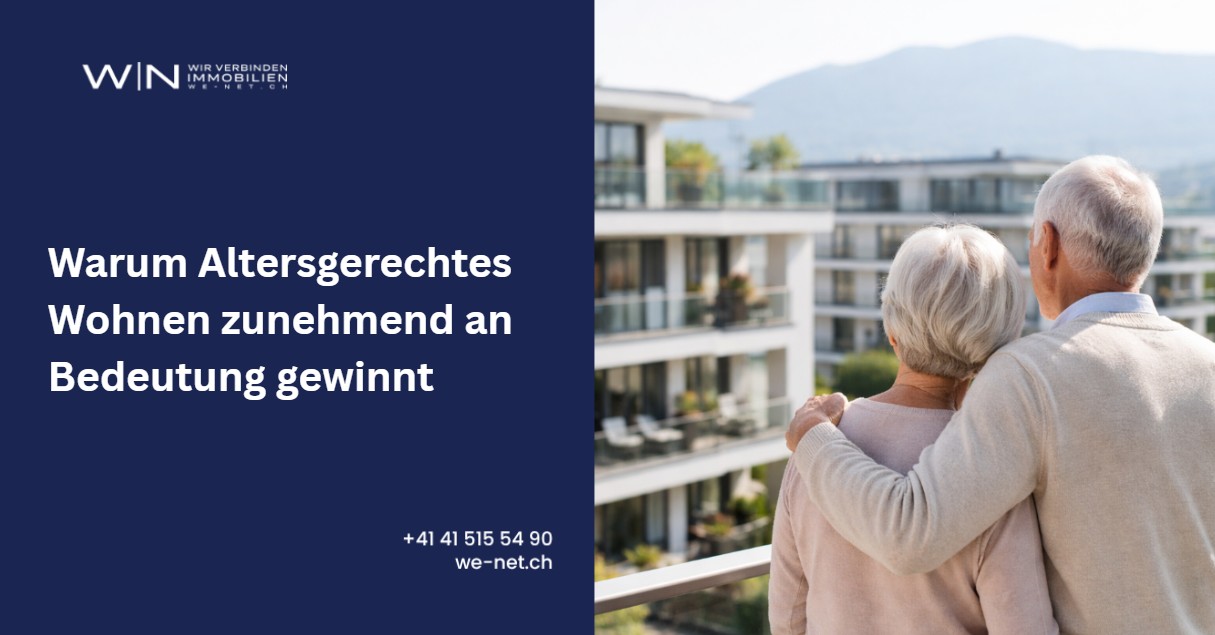
Age-appropriate living refers to modern living concepts for older people that combine comfort, security and independence. These include age-appropriate flats, barrier-free homes, assisted living and intergenerational neighbourhoods. The aim is to enable residents to lead a self-determined life, often in close proximity to medical care and social services.
An ageing society is changing the demand for housing
Life expectancy in Switzerland is among the highest in the world. At the same time, a large generation is reaching retirement age. More and more people are looking for forms of living that combine comfort, security and independence.
Today, it is no longer just about traditional care homes. Rather, modern living concepts such as
Age-appropriate flats
Barrier-free apartment blocks
Assisted living
Intergenerational neighbourhoods
Flats with proximity to medical infrastructure
Many senior citizens want to live independently for as long as possible. This so-called „ageing in place“ is becoming a central theme in the Swiss housing market.
Limited supply meets rising demand
At the same time, the supply of suitable properties remains limited. New buildings in Switzerland are subject to strict planning processes, rising construction costs and scarce building land reserves. Specialised forms of housing are therefore emerging more slowly than demand is growing.
There is also a typical Swiss market phenomenon: many owners remain in their existing single-family homes or large flats even in old age. This means that less living space becomes available, which continues to put pressure on the general housing market.
This trend is leading to an increasing importance of conversions, modernisations and targeted property adaptations.
| Key figure | Current status | Forecast | Significance for real estate |
|---|---|---|---|
| Proportion of population 65+ | 19.3 % (2023) | approx. 26 % until 2055 | Strong increase in demand for age-appropriate living |
| Population 80+ | 0.54 million people (2023) | approx. 1.1 million by 2055 | Doubling the need for assisted living facilities |
| Life expectancy for men | 81.9 years | rising further | Longer independent living phase |
| Life expectancy for women | 85.7 years | rising further | Increased demand for barrier-free flats |
| Age quotient (65+ to 20-64 years) | 31 people per 100 employees | approx. 48 to 2055 | Structural change in demand for housing |
| Private households 65+ | over 2.2 million people | growing strongly | More smaller, service-orientated flats |
Age-appropriate living as a stable property strategy
From an investor's perspective, the age-appropriate housing segment is becoming increasingly attractive. Compared to traditional property investments, it is characterised by several stable factors:
Long-term predictable demand
Low cyclicality
Sustainable lettability
Social relevance
Institutional investors such as pension funds and insurance companies are increasingly focussing their strategies on forms of housing with long-term usage requirements. Property that is tailored to demographic developments is increasingly seen as a defensive and future-oriented asset class.
Location quality remains crucial
Not every location is equally suitable for age-appropriate living. Locations with:
good medical care
public transport within walking distance
Shopping facilities in the neighbourhood
urban infrastructure with a high quality of life
Urban regions and economically strong agglomerations have particularly stable prospects here. At the same time, new opportunities are also emerging in well-connected regional centres.
Opportunities for owners and sellers
Demographic change affects not only investors, but also private property owners. Sooner or later, many will ask themselves questions such as:
Is my property age-appropriate in the long term?
What is the future demand for my property?
Does a sale, an adjustment or a repositioning make sense?
A well-founded market analysis is becoming increasingly important. Property decisions today are increasingly strategic and less purely emotional.
Property expertise through the ages
As a property company, WENET AG has been observing these structural developments very closely for years. The market is moving away from short-term trends towards sustainable utilisation concepts that take social changes into account.
Whether selling, valuing or strategically positioning a property: professional support helps to recognise opportunities at an early stage and make well-founded decisions.
Particularly in the context of demographic change, it is clear that property is not just living space, but also reflects long-term lifestyle and investment decisions.
A look into the future
The Swiss property market remains stable, but is more differentiated than in the past. Forms of housing for an ageing society are increasingly becoming an integral part of modern urban and neighbourhood development.
Those who deal with these developments today create the basis for sustainable property value tomorrow.
Age-appropriate living is therefore less a short-term trend than a structural change - and therefore an issue that will accompany the Swiss property market in the long term.
Sources
- Federal Statistical Office (FSO) - Population scenarios for Switzerland
https://www.bfs.admin.ch/bfs/de/home/statistiken/bevoelkerung/zukuenftige-entwicklung.html - Federal Statistical Office (FSO) - Life expectancy in Switzerland
https://www.bfs.admin.ch/bfs/de/home/statistiken/bevoelkerung/geburten-todesfaelle/lebenserwartung.html - OECD Data - Demography and Ageing Switzerland
https://data.oecd.org/pop/elderly-population.htm - Eurostat - Population Structure and Ageing
https://ec.europa.eu/eurostat/statistics-explained/index.php?title=Population_structure_and_ageing