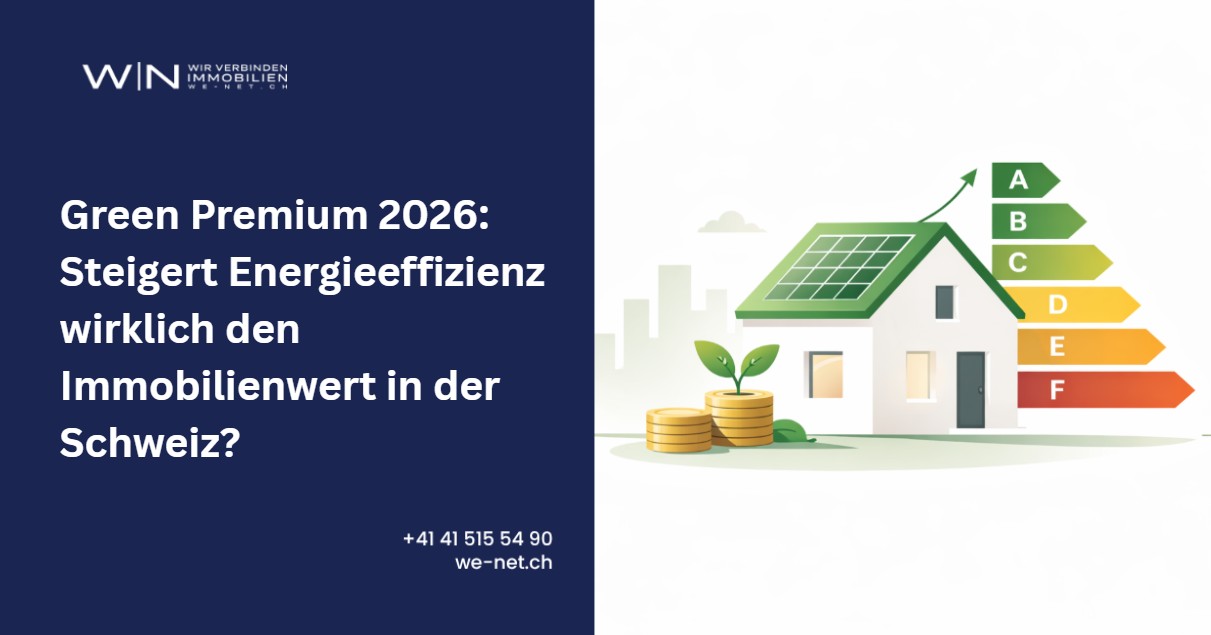
Sustainability is no longer a trend in the Swiss property market, but a structural valuation factor. Today, energy efficiency influences purchasing decisions, financing conditions and the long-term performance of properties. This raises a key question for property owners, investors and project developers:
Does high energy efficiency really lead to measurable added value?
Current market data, regulatory developments and transaction analyses clearly show that energy-efficient properties achieve a premium in many cases - and this is likely to become even more important in the coming years.
The regulatory framework: Net zero by 2050
Switzerland is pursuing the goal of climate neutrality by 2050. The building sector is responsible for around a quarter of domestic CO₂ emissions. Accordingly, cantonal energy laws are constantly being tightened. Fossil-fuelled heating systems are increasingly being replaced and energy-efficient renovations are being promoted or required by law.
- This has several consequences for owners:
- Oil heating systems are becoming less attractive and more expensive to maintain
- Heat pumps and district heating gain market acceptance
- The cantonal building energy certificate (GEAK) is becoming more important
- Banks are increasingly taking sustainability criteria into account in their risk assessment
Properties with poor energy performance therefore not only bear higher operating costs, but also regulatory and market risks.
What do studies say about the price premium?
Several market analyses by Swiss property consultancies show that certified or energy modernised properties can achieve price premiums.
| Feature | Very energy efficient (e.g. Minergie) | Conventional or unrenovated property |
|---|---|---|
| Price premium (sale) | approx. +2.45 % in the Canton of Zurich / +4.91 % in the City of Zurich | Reference index (0 %) |
| Rental price premium | about +3 % to +5 % higher net rents according to large Swiss analysis | Reference index (0 %) |
| Comfort & value retention | Strong positive influence on willingness to pay | Lower perceived comfort |
| Market positioning | Attractive for ESG-conscious buyers/tenants | less differentiated |
- Kempf & Syz (2022): Why pay for sustainable housing? Decomposing the green premium... - Price and rent premiums in the canton/city of Zurich (2.45 % / 4.91 %). Why pay for sustainable housing? Decomposing the green premium... https://link.springer.com/article/10.7007/s43546-022-00346-8
- Gantenbein et al. (University of Basel): The Rent Premium of Residential Minergie Buildings in Switzerland - Rent premiums 3-5 % for Minergie properties. The Rent Premium of Residential Minergie Buildings in Switzerland (Study Univ. Basel) https://wwz.unibas.ch/de/wwz-forum/projekte-und-publikationen/fv-71/
Typical observations from current studies:
- Minergie-certified residential properties often achieve a price premium of around 3-7 per cent
- Energy-efficiently refurbished apartment blocks have shorter marketing times
- Properties with low energy consumption achieve more stable rental income
- Buyers are prepared to accept higher purchase prices for calculably low ancillary costs
The market is increasingly differentiating between „future-proof“ properties and those in need of refurbishment.
The Swiss building stock: great potential, great risk
A significant proportion of Switzerland's housing stock was built before 1980. Many of these buildings have inadequate insulation, old windows or fossil-fuelled heating systems. At the same time, energy efficiency requirements are constantly increasing.
This raises a strategic question for owners:
Is an energy-efficient refurbishment a cost burden - or an investment in value retention and appreciation?
Renovation costs in the energy sector often range between CHF 400 and CHF 1,000 per square metre, depending on the scope. However, it is not only the level of investment that is decisive, but also the impact on the environment:
- Market value
- Rentability
- Financing conditions
- Long-term exit capability
Comparison: Energy-efficient vs. in need of refurbishment
The following is a structured overview of the most important differences in terms of market value, commercialisation period, financing and regulatory risk.
This table can contain key figures such as
- Average price premium
- Marketing period
- Average ancillary costs
- Financing conditions
- Long-term regulatory risk
Buyer behaviour 2026: Safety becomes a sales argument
In an environment of rising energy prices and growing uncertainty, buyers are placing increasing value on predictability. Low operating costs, modern heating systems and transparent energy parameters create trust.
This is particularly relevant for:
- Young home buyers with tight financing
- Institutional investors with ESG requirements
- Investment properties in urban centres
An energy-efficient property not only reduces running costs, but also future investment risks. This risk reduction is increasingly being priced in by the market.
Conclusion: Green Premium is real - but differentiated
Energy efficiency measurably increases property value in Switzerland, although the level of the premium depends heavily on the location, property type and quality of implementation. In regions with strong demand, good energy performance has a stabilising effect on the price and can trigger additional willingness to pay. In more peripheral locations, it increasingly determines marketability, as buyers attach greater importance to investment and regulatory security than they did a few years ago.
For WENET AG, one thing is clear: energy criteria are now part of the fundamental value analysis of a property. Those who renovate at an early stage and document sustainability professionally reduce risks and strengthen their market position in the long term. The question is no longer whether energy efficiency influences value, but how much the gap between efficient and inefficient properties will continue to widen in the coming years.